The Israel lobby’s fundraising capabilities started off small, but eventually became significant. As Grant F. Smith documented, “Between 1921 and 1930, Zionist organizations active in the United States collected approximately $15 million in contributions from the public. Between 1931 and 1940, this amount only rose to $25 million, but in the period from 1941 to 1948, the amount suddenly ballooned to $287 million.”[1] This major increase in cash was the result of the work of the United Jewish Appeal (UJA) founded in 1939. Thanks to the work of Zionist organizations, “Between 1951 and 1960, approximately $18 million of United Jewish Appeal money raised in the United States was transferred to the Jewish Agency in Israel and then on to Israeli political parties.”[2]
Isaiah Kenen was a Canadian-born Zionist who became an American citizen on June 8, 1934.[3] Kenen was committed to Theodor Herzl’s idea of a Jewish State. He even noted how “My father attended early meetings of the World Zionist Congress. He knew Herzl and other Zionist leaders.”[4] Kenen became president of the Cleveland Zionist District in 1940 at the urging of his friend Ezra Shapiro.[5] Kenen attempted to lobby for America to enter WWII by compiling a list of isolationists.[6] In 1943 he joined the American Emergency Committee for Zionist Affairs (AECZA).[7] He used this position to attack isolationists as anti-Semitic. The AECZA struggled to present an image to Americans of Jews being unified in support of Zionism due to the existence of Jewish anti-Zionist groups.[8] It was only when accounts of Nazi war crimes were publicized that the AECZA would gain strength and begin to successfully silence opposition.
Kenen was vehemently opposed to the 1939 British White Paper, which limited Jewish immigration to Palestine. He agreed with David Ben-Gurion, who said: “We shall fight the White Paper as if there were no war, and we shall fight the war as if there were no White Paper.”[9]
As the war winded down, Kenen worked to bring reparations and the creation of the state of Israel into public discourse, a task he was aided in by Henry Monsky, a B’nai B’rith organizer, and Louis Lipsky, who had served as president of the Zionist Organization of America (ZOA).[10]
Kenen extended his networking by participating in international conferences, representing the American Jewish Conference for the years 1945 and 1946.[11] He worked to persuade the UN to recognize Israel. Truman would eventually agree to recognize Israel amidst letter bombs sent to the White House by Zionist terrorists as well as Abraham Feinberg’s financing of his whistlestop campaign.[12]
Several years before this event, the U.S. government enacted a law to prevent foreign influence:
The rise of the American Emergency Committee for Zionist Affairs (AECZA) began one year after the passage of a law specifically aimed at curbing foreign influence over the US government. The Foreign Agents Registration Act (FARA) was enacted in 1938.[13]
FARA was later amended in 1942. As Smith explains:
The law was therefore designed not to directly restrict foreign propaganda, but to provide total public transparency over the operations of foreign agents in the US. Mandatory disclosure and fear of punishment would deter the most effective foreign propaganda campaigns, those which were launched as grassroots “American” initiatives. By 1942, FARA would ensure that propaganda was properly labeled as being paid for and distributed bearing the name and address of the registered foreign agent.[89] The secondary core purpose of FARA disclosure has always been to shield the US Congress and the president from foreign-influenced grassroots lobbying shaping policy, legislation and lawmaking.[14]
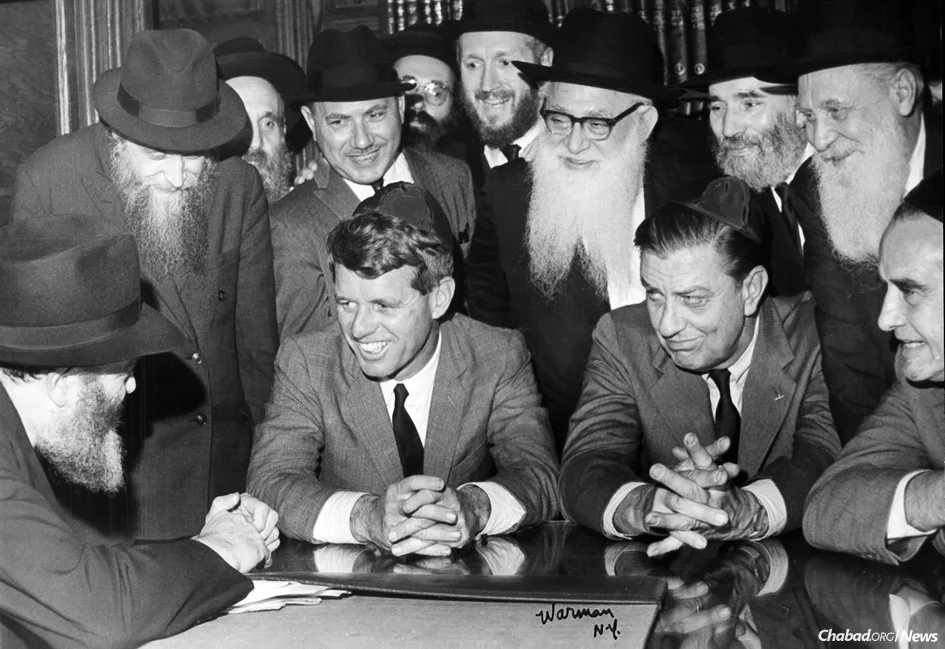
Initially a task of the U.S. State Department, it was later up to the U.S. Department of Justice to enforce FARA. During the Kennedy administration, the Attorney General of the DOJ was the president’s brother Robert.
Over the years, there were fewer and fewer applicants for FARA, including Zionist groups. Before the Kennedy presidency, Zionist groups were spreading propaganda for the interests of Israel, encouraging funding and migration for the Jewish Army.[15] Many of these lobbyists would be involved in smuggling U.S. military weaponry to Israel (including tanks and planes) like Rabbi Irving Miller (who worked for the Jewish Agency and the American Zionist Committee),[16] or funding Israel’s nuclear program, like Abraham Feinberg.[17]
Jack Kennedy was dependent on Jewish funding to win the Presidential election, but if his brother was successful in having the Israel lobby registered under FARA, Zionist power in America would be severely diminished.
The American Zionist Emergency Council (AZEC) was established in 1939, with its leaders being Abba Hillel Silver, Stephen Wise, and Louis Lipsky.[18] Internal disputes and discrediting led this umbrella organization to be recreated as the American Zionist Council [AZC] in 1949.
Kenen was a co-director of the Israel Office of Information (IOI), a lobbying organization that spread Israeli propaganda in the U.S. The IOI’s first FARA filing was received by the DOJ on October 12, 1948. On June 17, 1949, the FARA office decided the filing was “deficient,” and notified IOI to correct these deficiencies for the next filing statement. The IOI had limited the amount of information they disclosed, particularly regarding “all branches and local units of registrant,” as well as “detailed propaganda dissemination reports.”[19]
As part of the FARA process, Kenen had to submit his own unique foreign agent declaration with the DOJ, yet he omitted that he worked with officials of the Israeli government.[20]
Smith writes:
Kenen’s own preference for stealth can be seen on his personal 1948 FA-1 “short form” declaration. A cursory review of Kenen’s personal registration statement as director of the New York IOI office, filed with the Department of Justice on October 12, 1948, would have revealed it was unacceptable. Rather than disclose the titles and subjects of publications he had circulated in the previous six months at the Jewish Agency and UN, as required, Kenen simply noted that any he personally deemed covered under FARA had already been “filed” at his discretion.[21]
Further, “Kenen came to understand the burdens of FARA compliance, as he personally signed off on the Israel Office of Information’s FARA declaration for January 1–June 30, 1950 for all three offices.”[22]
Kenen spent a week on Capital Hill in January 1950 lobbying Congress to send weapons to Israel.[23] He never bothered to include this information in his FARA statements. Kenen would even go so far as to use a modified name for himself in his newspaper writings to make it more difficult for DOJ investigators to make the connection between his public lobbying and actions at the UN and Jewish Agency.[24]
One of the questions for the FARA declaration Kenen had to complete stated: “List all of your connections, not fully described above, with all foreign governments, foreign political parties, or officials of agencies thereof.” He wrote: “None.”[25]
Kenen left the IOI in 1951 to attempt to work with a lobby that could be registered as a domestic organization.
A January 17, 1951 memo by Nathan B. Lenvin, an attorney who worked for the Justice Department, reads:
Mr. Isaiah L. Kenen, Director of Information for the Government of Israel’s Mission to the United Nations and one of the officers of the Israeli Office of Information, visited my office on January 17, 1951 to discuss his possible obligations under the Foreign Agents Registration Act in the event he terminates his present activities and establishes his own public relations business.
Mr. Kenen stated that his first client would probably be the Government of Israel and consequently I told him that he should file a new registration statement on Form FA-1. I explained to Mr. Kenen the registration statement of the Israeli Office of Information and the necessity for the filing of a new statement. Mr. Kenen stated that he would file a new statement as soon as he commences his activities on behalf of the Government of Israel. Suitable forms were given to Mr. Kenen.[26]
Kenen wrote: “On January 31, 1951, it was decided that I should leave the Israeli government and spearhead the lobbying campaign for the [American] Zionist Council [AZC].”[27] He further wrote:
On February 13, [1951] I notified the Department of Justice that I was withdrawing as an agent of a foreign principal, and I then filed with the Clerk of the House and the Secretary of the Senate in conformity with domestic lobbying law.[28]
As he informed the FARA office:
This is to inform you that, effective today, I have resigned from the service of the Government of Israel.
I have been registered on an exhibit A form, as part of the registration of the Israel Office of Information.
Since January 1st, I was retained by the Government of Israel in an advisory capacity in the field of public relations. However, I have now changed my plans and severed my relations with the Israel Government. I would, therefore, request that my name be removed from your lists.[29]
His name was not removed from the DOJ’s lists. The New York Times published a story on February 29, 1952, about Kenen:
The appointment of I.L. Kenen, former director of information for the Jewish Agency in Palestine, as the Washington representative of the American Zionist Council, the public relations arm of Zionist groups in this country, was announced yesterday by Louis Lipsky, chairman of the council. Mr. Kenen, who also had served as director of information of the Israel delegation to the United Nations, recently returned from Israel.[30]
Kenen had been escorting U.S. Congressmen around Israel after they supplied the fledgling country with $65 million in foreign aid. As was hoped, these Congressmen returned to the U.S. more passionate about Israel. Representative Emmanuel Celler, for example, while a supporter of FARA, was a promoter of the Zionist cause, and did not see the Israel lobby as a group FARA would apply to.[31]
In response to The New York Times article, Kenen wrote a letter to the FARA office on March 14, 1952, attempting to explain why he shouldn’t be considered a lobbyist for Israel and forced to register as a foreign agent.[32] The chief of the FARA section simply responded that Kenen did not need to file if he did not promote propaganda.
Smith notes that “on February 27, 1952, the US agreed to sell weapons to Israel, partly as a result of Kenen’s ongoing Capitol Hill lobbying for arms that began while he was still on the payroll of the Israeli government’s Information Office.”[33]
While Kenen was working for the AZC in 1952, David Ben-Gurion held a meeting on November 23 with the leading representatives of four of the most prominent American Zionist groups.[34] The Jewish Agency, associated with the World Zionist Organization, was to have certain key functions transferred to the AZC. This meant the AZC, rather than the Jewish Agency operating in America, would focus on public relations for support of Israel.[35]
Kenen was the Washington Representative of the AZC from 1951 to 1953.[36] By 1954, with Rabbi Irving Miller serving as executive director of the AZC, the organization had a membership of 750,000.[37] The AZC, like its predecessor the AZEC, was an umbrella organization, and the two leading groups were Hadassah and the Zionist Organization of America (ZOA).[38]
Kenen considered his work for the AZC, which he began to lobby for in 1951, to be the beginning of the American Israel Public Affairs Committee (AIPAC), although the name AIPAC would not be applied until 1959.[39]
Eisenhower’s DOJ had threatened the AZC, as Kenen explained: “Then, late in December 1953, a Republican member of our Executive Committee, who worked in Washington, told our Committee that I might be a target.”[40] He further lamented,
Our acrimonious clashes with the Eisenhower-Dulles regime over arms and water led to rumors that the American Zionist Council faced investigation. The rumors were ill-founded but they were persistent and could not be ignored. We reorganized and established a lobbying committee—the forerunner of the American Israel Public Affairs Committee (AIPAC).
Between 1951 and 1953, I had been the Washington representative of the AZC, a tax-exempt organization. A government agency had ruled that only an insubstantial portion of AZC funds had been used for lobbying.[41]
Kenen reached an agreement with the DOJ that lobbying efforts by the AZC would not be done with tax-exempt funds. Nervous about the DOJ’s monitoring, the AZC set up a new committee:
Nevertheless, because of the possibility that we might be subject to attack, we organized a new and separate lobbying committee in 1954, independent of AZC control and financing and thus impervious to challenge. It was named the American Zionist Committee for Public Affairs (AZCPA). There was no change in leadership or membership, but we stopped receiving tax-exempt funds from the AZC. Instead, we solicited contributions which would not be deductible from income tax.[42]
This move was temporarily successful, as Smith notes:
The overriding issue of FARA registration, the AZC’s true foreign principal, using Israeli funds transferred from the Jewish Agency into the United States was thus successfully delayed for an entire decade. Not until the early 1960s would the Senate begin to investigate whether US aid sent overseas and other funds were being secretly laundered back into the US to obtain political influence and additional foreign aid; in 1963, a close examination of Isaiah Kenen’s financing revealed that this was indeed happening. This investigation was prompted by a crescendo of calls for enforcement made to the Department of Justice by the American Council for Judaism.[43]
Treasury Undersecretary Fred Scribner told Zionist groups in 1959 that to keep them from being prosecuted from various government agencies they needed to restructure the workings of their fundraising in the U.S. This led to the Jewish Agency transferring “Zionist activities to the American Zionist Council’s management, including youth immigration to Israel, propaganda, and Zionist cultural activities in the US” in 1960.[44] But this reorganization “also legally exposed the Jewish Agency and the American Zionist Council as they surreptitiously moved tax-exempt funds raised in the US and overseas into non-tax-deductible FARA-regulated propaganda operations, including Kenen’s lobbying newsletter.”[45]
The Near East Report was owned by Kenen, and he published 48 issues between 1957 and 1959.[46] It was financed by the Jewish Agency and laundered through the AZC.[47] He used it as a way for Zionist views to appear monolithic and speak for the entirety of the Israel lobby. Politicians critical of Zionism were attacked, such as Senator William Fulbright.[48] Kenen hated Fulbright’s support of resettling Palestinian refugees in Israel and his attack on the Israel lobby.[49] Kenen wrote:
There is growing recognition of the fact that the Arab refugee problem is not the cause of the Arab-Israel war. It is a result of that war and cannot be solved unless and until the war is abandoned.[50]
Kenen approvingly cited a speech by then-Senator John F. Kennedy given on June 14, 1960:
We must formulate, with both imagination and restraint, a new approach to the Middle East—not pressing our case so hard that the Arabs feel their neutrality and nationalism are threatened, but accepting those forces and seeking to help channel them along constructive lines, while at the same time trying to hasten the inevitable Arab acceptance of the permanence of Israel.[51]
Of course, Kenen’s opinion of Kennedy would change once Robert’s DOJ applied pressure to the AZC. The tolerance the DOJ exhibited towards the Israel lobby and its improper FARA filings would end with Robert Kennedy.
The AZC functioned as a nonprofit corporation, and thus,
it did not have to disclose the ultimate destination of funds transferred on to academics, lobbyists, and think tanks. These payments not only allowed Kenen to finance his own startup activities at AIPAC, but also paid for free Near East Report subscriptions for every member of Congress, large donors, editors, and allies in the private sector news and information services. Although the term “money laundering” was not used at the time, it is a highly accurate description of how this financial flow thwarted FARA.[52]
Kenen would continue to be on the payroll of the Jewish Agency in Israel, even into the 1960s.[53] Throughout the 1950s Kenen would focus on how to convince the U.S. government to give taxpayer-funded aid directly to Israel, instead of charitable donations.[54] Kenen was well aware that following FARA guidelines would prevent him from exhibiting the amount of Zionist influence in the U.S. he desired.
When Kenen heard rumors that Senator Fulbright would begin investigating foreign agents in 1961, he fled to Iran and then Africa, where he “was happy to find most African countries friendly to Israel.”[55] The following year, Fulbright investigators sifted through documents in the Jewish Agency’s filing cabinets.[56] The DOJ would be intimately involved in the Senate investigation.
The Jewish Agency and AZC were called in to testify by the Senate Committee in 1962.[57] The Senate quickly discovered how the AZC was an arm of Israel, and therefore required to register as a foreign agent.
A March 13, 1963, The New York Times article reads:
The Justice Department said today it was studying whether the American Zionist Council should be required to register as a foreign agency.
The acknowledgement, in response to reporters’ queries, was the first statement of the department on differences between the Zionist group and the American Council for Judaism.
The Council for Judaism has publicly urged that the Zionist Council be required to register as a foreign agency that promotes immigration to and advances the political policies of Israel.[58]
During the hearings, on August 1, 1963, Senator Fulbright said to Maurice Boukstein, the architect of the 1960 restructuring of the Jewish Agency:
for the life of me I can’t understand why a person who received such a large subsidy from a foreign agent indirectly, because it goes through the American Zionist Council, should not have to register, whereas if he received it directly, I think you would agree he would have to register, wouldn’t he? …. And the device of merely using the American Zionist Council seems to me to be a very thin way of insulating him [Kenen] from the effects of the Foreign Registration Act.[59]
After the May and August hearings in 1963, it was then left to the DOJ to enforce FARA and have Kenen register as a foreign agent.
While Fulbright’s hearings were proceeding, Robert Kennedy’s DOJ was pursuing FARA enforcement of the AZC. J. Walter Yeagley, who was then serving as Assistant Attorney General, sent a memo to RFK on October 31, 1962, telling him:
I think you ought to know that we are soliciting next week the registration of the American Zionist Council under the Foreign Agents Registration Act. In an amendment to a supplemental registration statement filed by the American Section of the Jewish Agency for Israel for the period ending in March 31, 1962, it was reported that the Council received over $32,000 in subventions and over $11,000 as a special grant from the American Section of the Jewish Agency for Israel. Under the Act the receipt of such funds from the Jewish Agency constitutes the Council an agent of a foreign principal as that term is defined in Section 1(c) of the statute. The stated purpose for which these funds were received makes unavailable any exemption from registration…You may be aware that the American Zionist Council is composed of representatives of various Zionist organizations in the United States including the Zionist Organization of America.[60]
Lenvin met with Maurice Boukstein on October 31, 1962, where Boukstein “hazarded a view that perhaps the most that would be sought would be a non-pressing by A. G. of any request for registration on the basis of bona fide representations that the Jewish Agency no longer would contribute funds to the American Zionist Council.”[61] But as the Senate hearings revealed the extent of the Jewish Agency’s funding of the AZC, the pressure by the DOJ became much stronger.
RFK wanted to know if he could successfully enforce FARA against the AZC, so he called in Department of Justice Director of Public Information Edwin Guthman to appraise the situation. Guthman’s report was sent to RFK and copied to Nicholas Katzenbach, the Deputy Attorney General, on November 14, 1962. Guthman described the meeting he had with Yeagley and Nathan Lenvin, who worked in the FARA section:
I met with Walter Yeagley and Nat Lenvin today in connection with the proposal to require the American Zionist Council to register under the Foreign Agents Registration Act.
The facts as set forth in the attached memorandum from Yeagley and Lenvin show clearly that the American Zionist Council has been receiving substantial amounts of money for two years or more from the American Section of the Jewish Agency for Israel for the express purpose of disseminating propaganda about Israel’s position in the Middle East. This money comes from funds raised in America through the United Jewish Appeal.
Nat Lenvin proposes to write a letter to the American Zionist Council indicating that the Council should register. Undoubtedly, representatives of the Council will wish to confer with Nat.
I believe that Nat should go ahead and send the letter and handle this matter as any other registration. I doubt very much that there will be any fuss. I don’t think the American Zionist Council is in any position to do so. If, as it appears, the Zionist Council has used for political propaganda purposes money raised by the UJA in America, the Council has compromised its position. This UJA money is generally for charitable work in the United States and Israel. Disclosure that some of the money—even a small part—had been used for political propaganda could hurt the UJA fundraising.[62]
Yeagley sent FARA forms to the AZC on November 21, 1962, with an accompanying letter expressing the opinion that since the AZC was engaged in propaganda using Jewish Agency funds, it was a foreign agent.[63]
A letter dated December 6, 1962, sent from Rabbi Irving Miller of the AZC to Lenvin, included his complaints and a wish to delay the registration for 120 days.[64]
On January 2, 1963, Kenen incorporated AIPAC, but did not register the new lobby under FARA.[65]
The AZC decided to hire attorney Simon H. Rifkind of Paul, Weiss, Rifkind, Wharton & Garrison LLP to fend off the DOJ. Lenvin and his assistant Thomas K. Hall met with Rifkind, a member of his law firm, and two people who represented the AZC on January 23, 1963. Hall recollects the meeting in a memo the following day:
Judge Rifkind indicated that he had carefully reviewed the facts and the pertinent provisions of the Foreign Agents Registration Act and had concluded that while the situation is fraught with considerable doubt he had advised his client to discontinue completely the agency relationship and cut off the receipt of any additional funds of this nature. This action he stated on the part of this client became effective on January 18. He stressed the fact that his client and its activities fall within the purview of the so-called educational or cultural exemption of the Act. There were, however, certain activities such as the dissemination of publications and the use of mass media as to which it could conceivably be argued they were non-exempt. In the light of this he deemed it advisable that his client terminate the relationship in its entirety.[66]
Rifkind went on to say the AZC was going to struggle by raising its own funds in the U.S. after refusing cash disbursements from the Jewish Agency. Lenvin said the AZC would still be required to retroactively register for when propaganda was done while the AZC was still subsidized by the Jewish Agency. Rifkind, losing the debate, then explained the AZC had a moral obligation to not sign the FARA forms because
…it would not benefit the government at this time to obtain such a registration and the disclosure involved; that registration would place a noose around the neck of his client, a long-standing organization of excellent repute and important to the national interest of the United States and thus choke the very life out of it; that registration would furnish a weapon to anti-Zionist groups, a spokesman of which is alleged to have said he would pay a half million dollars to get AZC registered as a foreign agent.[67]
Lenvin received an outline from Rifkind’s law firm on March 21 on why the AZC cannot be required to register as a foreign agent. A meeting followed on April 1, with Hall and Lenvin speaking with Rifkind and several of his law firm members.[68] Lenvin reiterated the need for the AZC to register because of its relationship with the Jewish Agency. The AZC responded by saying it would prove all of the informational materials it produced and sent out were under the exemption clause.[69]
Katzenbach, Yeagly, and Lenvin met with Rifkind in his firm’s law offices on May 2, 1963. Lenvin recounted how Rifkind claimed the AZC represented “the vast majority of organized Jewry in the country,” and “that for the Department to insist upon the registration of the Council would do it incalculable harm without any corresponding benefit to the government.”[70] He lamented that Zionists could not understand how the DOJ “could do such harm to the Zionist movement and impair the effectiveness of the Council by insistence on registration.”[71] He also said the DOJ should ignore the AZC just as not all traffic violators receive tickets.
During this meeting, Katzenbach gave Rifkind an offer that thwarted the FARA process:
Mr. Katzenbach then noted that if the Council made a full disclosure of the receipt and expenditure of the funds it received from the Jewish Agency so that such information would then be available for public inspection the purposes and objectives of the Registration Act might well be accomplished and very likely there would be nothing further for the Government to do.[72]
A June 28, 1963 article in The Wall Street Journal alerted Americans to the government’s battle with the AZC:
FEDERAL LAWYERS near decision on whether to require the American Zionist Council to register as an agent of the Israeli government. High Justice Department officials weigh the risk of offending Jewish opinion in the US. Senate Foreign Relations Chairman Fulbright also eyes the council’s activities.[73]
This article resulted in RFK and Congress receiving an influx of public complaints. One letter sent to RFK from a Jewish couple read: “We wish to practice our religion of Judaism without any involvement with a political subsidiary of any foreign state, therefore, we urge you as Attorney General look seriously at the American Zionist Council for political involvement with the State of Israel and thus necessitating it to register as a foreign agent.”[74]
Exchanges between the AZC and DOJ would continue, and because of Katzenbach’s offer, the DOJ could never get the documents needed for FARA filing. As Smith writes:
As the true volume of Jewish Agency payments was registered in the Senate record in 1963, Rifkind and the AZC would alternately delay, reinterpret, flood the section with irrelevant data and ruthlessly exploit this “Katzenbach concession” to avoid filing the requested information. This lasted until the cover provided by the JFK administration was suddenly and violently destroyed forever.[75]
Yeagley still pushed for a full FARA filing, especially as the Fulbright hearings revealed how vast the AZC’s activities were.[76] Katzenbach had to cancel his concession because of this new evidence. Rifkind continued to delay as the year progressed, protesting the registration. During a meeting on October 17, he said “that it was the opinion of most of the persons affiliated with the Council that such registration would be so publicized by the American Council for Judaism that it would eventually destroy the Zionist movement.”[77] Katzenbach would follow the political winds of the new administration by not demanding the AZC to register under FARA with the same pressure as the Kennedy administration. RFK was still Attorney General, yet with Lyndon Johnson being president, Katzenbach returned to his concessional attitude.
On December 11, 1963, Rifkind informed the FARA office that “our client is not prepared to register as an agent of a foreign principal, or to concede that it is subject to the registration requirement.” He attached AZC records of payments and stated, “We request, however, under the circumstances, that these papers be kept in files of the Department not available for general public inspection.”[78] Yeagley reviewed these documents and then corresponded with Katzenbach on December 13, 1963, explaining how the documents provided are insufficient and “This Division would then recommend prosecution of the Council and possibly some top officials to the Attorney General.”[79]
Katzenbach told Yeagley to have Lenvin send a letter to Rifkind, written in a “friendly, rather than a hostile tone and rather brief, generally to the effect that the material be[ing] submitted is not satisfactory or not what we expected, or etc. and adding if Judge Rifkind is going to be in Washington in the near future he hopes he will come in to see him.”[80]
A January 31, 1964 meeting Lenvin attended at Rifkind’s law office resulted in Rifkind explaining how the American Council for Judaism was charging “that the Zionists were acting as propaganda agents for the State of Israel and that the Jewish Agency was being used as a conduit for funds to Zionist organizations in the United States,”[81] and Rifkind was “concerned that any disclosures which were to be made by the subject organizations should not be such as to substantiate these charges made by the American Council.”[82]
Rifkind then spoke of Katzenbach as being “relaxed” in regard to FARA, and the AZC could be more selective with their public financial disclosures. Lenvin tried to argue, but Rifkind explained how Katzenbach held that the DOJ “did not wish the American Zionist Organization to go to undue expense and trouble in providing this information, and that the Department would be reasonable in regard to the period and details which this statement would contain.”[83]
Further,
As if to punctuate that the AZC registration issue was now merely a low-level technical matter that would be resolved with preferential treatment, Rifkind announced that he would personally “not need to participate in the future” and officially delegated attorney Nathaniel S. Rothenberg as the new key contact before the Department of Justice on the matter. On the way out, Rothenberg stressed to Lenvin “one caveat, that they would have to be sure that anything they submitted would not ultimately prejudice the organization in the eyes of the public.”[84]
The January 31 meeting notes were reviewed by Irene Bowman of the FARA office, who was infuriated by what was happening, describing her angst in a memo to Yeagley and Edwin Guthman: “I don’t see how we can accept a caveat that an organization won’t submit information that might prejudice it publicly. I hope Nathan made clear to Mr. Rothenberg that is not the test. I think we should advise Rothenberg that the worst that the Council can do publicly is to stall and delay in submitting the financial information which the law clearly requires.”[85]
It is well known that RFK and Lyndon Johnson were bitter enemies, and it is no surprise that RFK could not successfully fulfill his duties as Attorney General in the Johnson administration. In early 1964, he started preparing for a Senate run in New York. By this point, reigning in the Israel lobby could not be done under Lyndon Johnson.[86] Abraham Feinberg “enjoyed the greatest presidential access and influence in his twenty years as a Jewish fund-raiser and lobbyist with Lyndon Johnson.”[87] Smith writes:
Although applying FARA to the Israel lobby was swept off the table by the Johnson administration, pursuit of FARA violations related to other small countries remained active. But the fact remains that any deep FBI or FARA investigation into Abraham Feinberg concerning Israel’s nuclear weapons program would have created presidential campaign contribution chaos.[88]
A February 10 letter from Yeagley to Rothenberg requested compliance with the disclosure of necessary finances. When Rothenberg responded to the letter on March 16, he brought up the Katzenbach concession:
You are familiar, I know, with the agreement reached between Judge Rifkind and Mr. Katzenbach, in the presence of Mr. Yeagley, with regard to additional information to be furnished your Section. Such agreement was reached, as I understand it, in the realization by Mr. Katzenbach that with the present size of the staff of the Council it would be indeed burdensome to furnish your department with itemization of expenditures of the past two years. A sample itemization was therefore forwarded to you for a period of approximately three months.[89]
Yeagley then sent a memo to Katzenbach, asking for his opinion on what action to take next: “Nick, This is the most blatant stall we have encountered. Do you mind suggesting what we do next because all of us here would call their records before a grand jury.”[90] In Katzenbach’s subsequent letter to Rothenberg, he said the three-month samples do not meet FARA requirements, but at the same time did not specify the limits of his concession.[91] He further stated: “While we have endeavored to make our requests as reasonable as possible, we cannot accept your suggestion since the information offered is not in compliance with the Act or what we thought our understanding was with Judge Rifkind.”[92]
Smith writes:
On October 22, 1964, Katzenbach briefly attended his last formal meeting on the AZC matter with Rothenberg, Yeagley, and Lenvin. The meeting was the beginning of a cascading series of capitulations to AZC demands for special treatment. Katzenbach then became acting attorney general in September when Robert F. Kennedy resigned from the Department of Justice to begin his run for a New York Senate seat.[93]
At the October 22 meeting, Katzenbach gave a full capitulation to the AZC, as recounted by Nathan Lenvin: “Mr. Katzenbach had to excuse himself because of urgent business elsewhere, but before he left he made clear to Mr. Rothenberg that, in response to the latter’s assertion that to submit all of the financial information we had previously requested for a two to two-and-a-half year period would be a great burden on the subject, we would accept a statement as to a typical three month expenditure projected for the entire period concerned.”[94] In addition, “Mr. Rothenberg replied to Mr. Katzenbach that the Department could take any three month period it wanted, but Mr. Katzenbach made it clear that it was their responsibility to pick a three-month period that would reflect by projection the true state of the expenditures made by the Public Information Department of the American Zionist Council.”[95] Yeagley would continue to follow Katzenbach’s concession of limited three-month period expenditure reports of the AZC, rather than a complete and detailed financial report.[96]
Rothenberg asked that the names of public speakers hired by the AZC who received indirect money from the Jewish Agency should not be made public, and Katzenbach agreed to this concession. Yeagley suggested the speakers list to be contained in a non-public file located in the FARA public registration office.[97]
On October 24, when Bowman read through the next documents submitted by the AZC, she found they were still lacking, for they did not detail where AZC funds were allocated.[98]
Rothenberg told Lenvin on November 4 that he would provide a list of expenditures of the AZC for the months of April, May, and June of 1962, hoping that it would meet Katzenbach’s concession.[99] But on November 18, Yeagley protested to Rothenberg:
it was intended, however, that the reporting period would be the entire period with which we are concerned, for example January 1960 to April, 1962. Mr. Katzenbach agreed, however, that the report for the full period could be prepared by projecting a typical three month period and that as long as you were satisfied that the sample period selected was representative of the entire period and would result in a reasonably or substantially accurate report, he would be willing to accept it in that form.[100]
Smith summarized this move: “The Department of Justice had now capitulated, via Yeagley, on any right to compare the three-month expenditures to an actual year of true income and expenses.”[101] Rothenberg replied in a letter on November 23 that the AZC would comply with preparing a report for the FARA office. Come January 19, 1965, there was still no AZC declaration sent. Bowman asked that Yeagley follow-up on this with Rothenberg.
On January 28, 1965, Katzenbach was appointed as attorney general by Lyndon Johnson.
When Rothenberg was asked by Lenvin on the cause of the delay of the filing on February 25, he told Lenvin it was caused by “the inability to collect all of the information we wanted in the detail it was indicated the Department desired; however, he assured me this material had now been collected and was in the process of being put into proper form…”[102] Yeagley responded: “I told Mr. Rothenberg we had depended to some extent on his good faith in assuring us that the material would be coming in, and that I would not like to believe that he did not intend to adhere to the assurances he gave to Mr. Katzenbach during the course of the above referred meeting.”[103]
Harry A. Steinberg, Executive Directive of the AZC, sent a list of payments to the DOJ on March 2 that contained total disbursements of $37,986.92 for the period April 1, 1962, to June 30, 1962. He emphasized that this list be kept non-public.[104] This list was meant to be deceptive:
It did not divulge any of the payments to Isaiah Kenen that the Jewish Agency had specifically slated for the Near East Report. Those incremental payments, totaling $38,000 disclosed in the Senate hearings were made much earlier—between June 29, 1960 and October 13, 1961.[105]
A March 4, 1965 memo from Lenvin to Bowman shows Lenvin’s evident alleviation of the AZC affair winding down:
Apparently my visit with Mr. Rothenberg has had at least some concrete results. If we can reasonably find that this is in substantial compliance with the understanding reached between Messrs. Rothenberg and Katzenbach in regard to what this organization would report, then I believe we should try to write “finis” to this at least for the time being. If you do find this fairly satisfactory, then we should make an effort to gather the other material which has been submitted including the propaganda material and, if possible, make one file which would then be available for public inspection should such an occasion arise.[106]
Bowman, under duress at the moment, initially expressed agreement that the material submitted was sufficient for a FARA registration statement, but later recanted. A March 24 file displays her true opinion. After listing the inadequacies of AZC documents, she states bluntly: “the writer is opposed to the acceptance of the material submitted by the AZC as a registration statement.”[107]
Lenvin sent a memo to Yeagley on March 31, which reads: “At this stage in the game, our only alternative would be to institute prosecutive proceedings. Since in my view this would be impractical, I recommend that the material submitted be accepted as a registration statement and put into such form as would be available for public inspection in the event such an occasion should arise.”[108] Lenvin gave approval to Rothenberg’s claim that “no useful purpose would be served by including these names in the material which would be made available for public inspection.”[109] This put the AZC in a unique situation, where it had a “special joint public-secret filing at the FARA section.”[110]
On April 8, Lenvin then gave his seal of approval on the filing:
The material filed by the American Zionist Council (AZC) was filed in accordance with an understanding between the Department and the AZC and was filed as a result of a bona fide dispute between the parties as to whether registration was, in fact, required under the Foreign Agents Registration Act. Neither party was inclined to test the applicability of the statute in a criminal proceeding. Thus it was agreed that the material would not comprise a registration statement but would supply basic information regarding the activities of the AZC financed in part by the Jewish Agency, American Section, Inc. This material is available for public inspection.[111]
Yeagley notified the FBI on May 14 with similar wording as Lenvin’s April 8 memo. He writes:
For your information the AZC has submitted informational material which is available in the Registration Section for public examination. This material was filed in accordance with an understanding between the Department and the AZC and was filed as a result of a bona fide dispute between the parties as to whether registration was, in fact, required under the Act. The material does not comprise a registration statement but does supply basic information regarding activities of the AZC financed in part by the Jewish Agency, American Section, Inc.[112]
In a May 17 memo, Yeagley advised Lenvin on what to do with the AZC documents now that the dispute was finished:
The material filed by the AZC was placed in an expandable portfolio to distinguish it in appearance from the registration statements which are filed in manila folders. In the event Mrs. Eldred receives inquiries as to whether the AZC is registered under the Act, she has been instructed to respond in the negative. She is to advise, however, that the AZC has filed information with this Section which is available for public examination.[113]
A final note from Yeagley on May 20 reads, “Ok. This seems to be what Attorney General Kennedy and the then Dep. AG Katzenbach had in mind.—JWY.”[114] Just one month later, Kennedy was warning the Senate about the dangers of Israel obtaining nuclear weapons.[115]
On November 27, 1967, AIPAC applied to receive an IRS tax exemption.[116] On January 1 of the following year, they granted AIPAC the exemption, “retroactive to 1953 according to the determination letter, recognizing AIPAC to be the continuance of an unincorporated group called the American Zionist Committee for Public Affairs—which was never functionally separate from the American Zionist Council.”
Lyndon Johnson’s aunt, Jesse Johnson, was a member of the ZOA, hence it is not surprising that the new president would not continue Robert Kennedy’s crusade against the lobby.[117] No serious effort has been made to confront the Israel lobby since the Kennedy administration.
This entire episode is summarized well by Smith: “AIPAC assumed a leading position in the Israel lobby in 1963 after the American Zionist Council’s functions were transferred to AIPAC following its conflict with the US Department of Justice and compelled nonpublic FARA filing.”[118]
[1] Grant F. Smith, America’s Defense Line: The Justice Department’s Battle to Register the Israel Lobby as Agents of a Foreign Government (Washington: Institute for Research: Middle Eastern Policy, 2008), Kindle edition, 134-135.
[2] Ibid, 137.
[3] Ibid, 24.
[4] Ibid, 29.
[5] Ibid, 24-25.
[6] Ibid, 25.
[7] Ibid, 26.
[8] Ibid, 26.
[9] Ibid, 27.
[10] Ibid, 27.
[11] Ibid, 27.
[12] Smith, 52; Eric Pace, “Letter‐Bombs Mailed to Truman in 1947,” The New York Times, December 2, 1972, https://www.nytimes.com/1972/12/02/archives/letterbombs-mailed-to-truman-in-1947-truman-was-sent-bombs-book.html
[13] Smith, 62.
[14] Ibid, 64.
[15] Ibid, 82.
[16] Ibid, 84.
[17] Ibid, 53.
[18] Ibid, 102.
[19] Ibid, 91.
[20] Ibid, 92.
[21] Ibid, 95.
[22] Ibid, 92.
[23] Ibid, 95.
[24] Ibid, 96.
[25] Ibid, 97.
[26] Ibid, 90.
[27] Ibid, 100.
[28] Ibid, 100.
[29] Ibid, 100-101.
[30] Ibid, 108.
[31] Ibid, 112.
[32] Ibid, 109.
[33] Ibid, 113.
[34] Ibid, 105-106.
[35] Ibid, 106.
[36] Ibid, 110.
[37] Ibid, 106.
[38] Ibid, 106.
[39] Ibid, 106.
[40] Ibid, 114.
[41] Ibid, 114.
[42] Ibid, 114-115.
[43] Ibid, 115.
[44] Ibid, 137.
[45] Ibid, 138.
[46] Ibid, 119.
[47] Ibid, 129.
[48] Ibid, 120.
[49] Ibid, 122.
[50] Ibid, 123.
[51] Ibid, 123-124.
[52] Ibid, 129.
[53] Ibid, 98.
[54] Ibid, 93.
[55] Ibid, 133.
[56] Ibid, 154.
[57] Ibid, 138.
[58] Ibid, 134.
[59] Ibid, 151.
[60] Ibid, 155.
[61] Ibid, 161.
[62] Ibid, 156.
[63] Ibid, 160.
[64] Ibid, 161.
[65] “The American Israel Public Affairs Committee (AIPAC),” The Israel Lobby Archive, https://www.israellobby.org/AIPAC/default.asp.
[66] Smith, 162.
[67] Ibid, 164.
[68] Ibid, 166.
[69] Ibid, 166.
[70] Ibid, 167.
[71] Ibid, 168.
[72] Ibid, 170.
[73] Ibid, 170-171.
[74] Ibid, 173.
[75] Ibid, 170.
[76] Ibid, 177.
[77] Ibid, 179.
[78] Ibid, 191.
[79] Ibid, 193.
[80] Ibid, 193.
[81] Ibid, 193.
[82] Ibid, 193-194.
[83] Ibid, 194.
[84] Ibid, 194.
[85] Ibid, 195.
[86] Ibid, 188.
[87] Ibid, 188.
[88] Ibid, 191.
[89] Ibid, 197.
[90] Ibid, 197.
[91] Ibid, 198.
[92] Ibid, 198.
[93] Ibid, 200.
[94] Ibid, 200.
[95] Ibid, 200.
[96] Ibid, 202.
[97] Ibid, 201.
[98] Ibid, 198.
[99] Ibid, 201.
[100] Ibid, 202.
[101] Ibid, 202.
[102] Ibid, 202.
[103] Ibid, 202-203.
[104] Ibid, 203.
[105] Ibid, 203.
[106] Ibid, 205.
[107] Ibid, 207.
[108] Ibid, 207.
[109] Ibid, 207.
[110] Ibid, 208.
[111] Ibid, 208.
[112] Ibid, 209.
[113] Ibid, 209-210.
[114] Ibid, 210.
[115] Jack Day, “RFK and Israel’s Nuclear Program,” Locals, June 26, 2023, https://eclecticanecdotes.locals.com/post/4206133/rfk-and-israels-nuclear-program.
[116] “The American Israel Public Affairs Committee (AIPAC),” The Israel Lobby Archive, https://www.israellobby.org/AIPAC/default.asp.
[117] Lenny Ben-David, “A friend in deed,” The Jerusalem Post, September 8, 2008, https://www.jpost.com/features/a-friend-in-deed.
[118] Smith, 246.
Leave a Reply
You must be logged in to post a comment.