
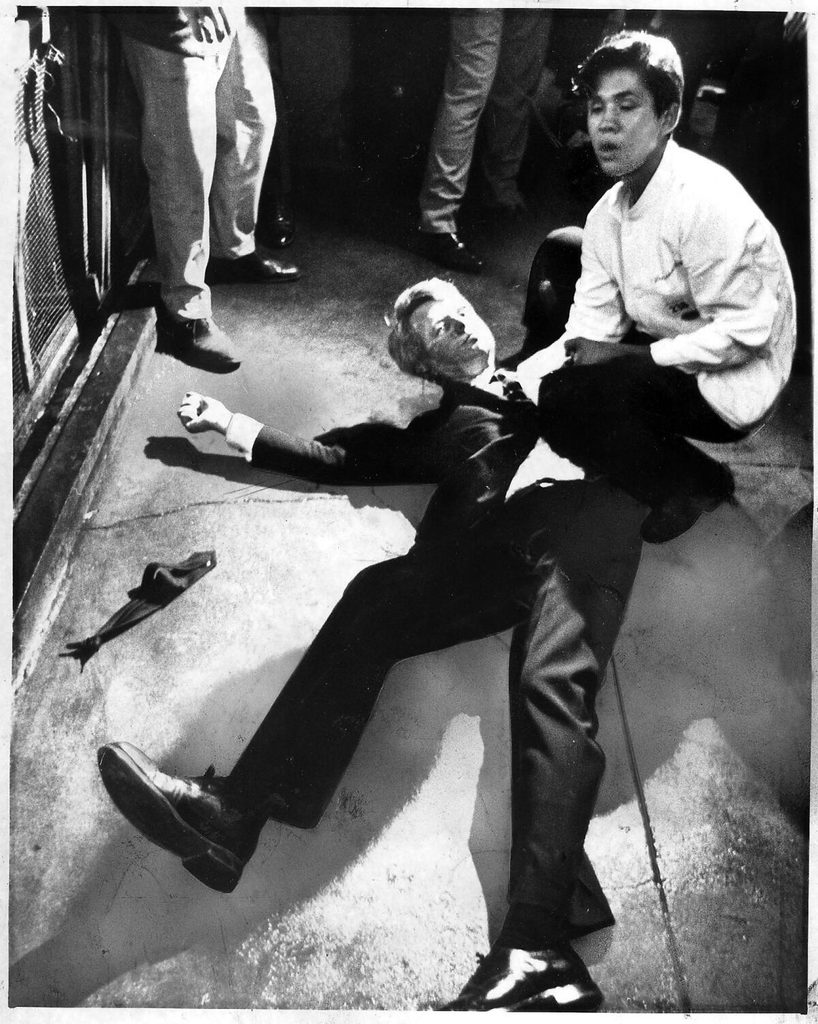
The Robert F. Kennedy assassination doesn’t have the amount of interest as his brother John’s assassination does. Nevertheless, there are three major theories put forward by conspiracy theorists about who killed him: Israel, the CIA, and the Mafia.
In a Senate speech on June 23, 1965, RFK warned of how near Israel was to acquiring nuclear weapons:
Five nations now have the capacity to explode nuclear bombs. This capacity was developed at great cost, over a period of a generation. But at least a dozen, perhaps a score, of other nations are now in a position to develop nuclear weapons within 3 years. Two of these nations—Israel and India—already possess weapons-grade fissionable material, and could fabricate an atomic device within a few months.
…
Israel and Egypt each have been deeply suspicious of the other for many years, and further Israeli progress would certainly impel the Egyptians to intensify their present efforts.[1]
He made it clear that he would follow in his brother’s footsteps in pursuing nonproliferation:
[T]he proliferation of nuclear weapons immensely increases the chances that the world might stumble into catastrophe.
President Kennedy saw this clearly. He said, in 1963:
“I ask you to stop and think what it would mean to have nuclear weapons in so many hands, in the hands of countries large and small, stable and unstable, responsible and irresponsible, scattered throughout the world. There would be no rest for anyone then, no stability, no real security, and no chance of effective disarmament.”
There could be no stability anywhere in the world-when nuclear weapons might be used…between Arabs and Israelis over the Gaza strip….But if nuclear weapons spread, it is dangerously likely that they will be so used—for these are matters of the deepest national interest to the countries involved.
…
It is clear, in short, that the United States—and the entire world-have the most vital interest in preventing the scattering of nuclear weapons.[2]
However, when we look to the background of the convicted assassin of RFK, Sirhan Sirhan, we do not see a Zionist assassin, but an anti-Zionist assassin.
Sirhan was born in Jordan and experienced trauma during his childhood while living in Israel. After having survived a bombing at the Damascus Gate perpetuated by the Jewish terrorist organization Irgun,
the four-year-old [Sirhan] witnessed five other separate incidents of violence and death during the rest of the family’s stay in Musrara. After one incident, Mary said, Sirhan “was pale for some time. Wouldn’t move for some time. Couldn’t move. Fainted. After a truck full of dynamite exploded near our home Sirhan wouldn’t go out of the house for days…. Sometimes he would talk in his sleep …. One night, living in Old Jerusalem, I felt him and he was cold like a stick. More than any of his brothers, he had less blood and more fear.” Mary also said Sirhan would go into trancelike states. Later, when he was eight years old, Sirhan witnessed the death of his brother Munir (after whom the Sirhans’ youngest child was named) when a runaway Army truck, trying to avoid a sniper, struck the child in St. Paul’s Street. Sirhan remembered an Arab military checkpoint at Jerusalem’s Zion Gate and an Arab soldier there who let him look through binoculars at the Jewish part of the city. The Arab soldier told Sirhan that all the land he could see belonged to them.[3]
When Sirhan and his family moved to America, his hatred of Israel did not lessen. A friend of Sirhan’s, Walter Crowe, said that Sirhan violently hated Israel.[4]
Mel Ayton writes of Sirhan’s familiarity with RFK’s political stance towards Israel:
On June 1, in his televised debate with Senator McCarthy, Kennedy said, “I do think we have some commitments around the globe. I think we have a commitment to Israel, for instance, that has to be kept. But what I don’t think is that we can be the policemen of the world.”49 Both McCarthy and Kennedy said that the United States should send Phantom jets to Israel, but McCarthy was in favor of replacing only the eighteen jets that Israel lost in the 1967 war on a one-to-one basis. Kennedy advocated sending fifty jets. On June 1 he had also spoken at the Temple Isaiah, again wearing a yarmulke and again giving his support for the sale of fifty Phantom jets to Israel. The speech was carried over the radio on station KFWB and was heard by Pasadena resident, Mary Sirhan, who reported it to her son, Sirhan.[5]
When Sirhan was arrested, he had a newspaper clipping on him that said the following:
Presidential candidates are out to get votes, and some of them do not realize their own inconsistencies. Just the other day, Senator Robert F. Kennedy of New York made a speech in Los Angeles which certainly was received with favor by Protestant, Catholic and Jewish groups which have been staunchly supporting the cause of Israel against Egypt and the Arab countries…. Lots of people … think the situation in the Middle East is not nearly as dangerous as the situation in South-East Asia. Also there are many members of Congress who feel that it is proper for the United States to render military support to Israel in the Middle East, it is just as necessary to protect the countries of South-East Asia against aggression …. A large number of people in this country are deeply concerned with the events in the Middle East, particularly with the fate of Israel. Hence the political candidates see a big advantage in proclaiming their support of American intervention in the Middle East.[6]
The claims of Mafia and CIA involvement have both been focused on a security guard named Thane Eugene Cesar, who was providing security at the Ambassador Hotel that night along with other employees of Ace Security.
Lisa Pease, in her book A Lie Too Big to Fail: The Real History of the Assassination of Robert F. Kennedy, claimed she found documentation from public records databases showing Cesar was employed by the CIA as a contract agent, but she has never provided said documentation.[7]
Don Schulman, a news runner present in the Ambassador Hotel, said that he saw a security guard fire his gun during the assassination. But as Ayton writes,
Schulman later retracted his statement of having seen a second gunman citing his confusion during the chaotic moments of the shooting. In the mid-1970s Schulman told the Kranz Investigation (which was set up by the Los Angeles authorities to look into allegations made by conspiracy theorists) that immediately following the shooting he was ‘tremendously confused’ and that the words he used to describe the shooting to reporters in 1968 were the result of ‘confusion’. Schulman reported that he meant to tell reporters that, ‘Kennedy had been hit three times, he had seen an arm fire, he had seen the security guards with guns, but he had never seen a security guard fire and hit Robert Kennedy.’[8]
David E. Scheim wrote of what crime investigator Alex Bottus told him:
According to Bottus, Cesar’s detention “was all fixed by none other than John Alessio,” an alleged Mobster from California who had been a director of the conglomerate that controlled the U.S. National Bank. And Cesar’s organized crime ties, Bottus claimed, were demonstrated by “his whole track record.” “You trace him either through Missouri, Arkansas, and go down like I said into Chula Vista, you get down in University City, you get down into Tijuana, they all know about Cesar. And this guy’s got connections like crazy.”[9]
But Scheim admits, “the evidence is merely suggestive, and any definite links among Cesar, Sirhan and the Mob have yet to be found.”[10]
The only clear direct connection Cesar had to the Mafia came from Cesar’s own mouth during conversation with Dan Moldea:
In the midst of lunch, Cesar casually told me about some unusual diamond purchases he had made with his own money. He added that he had bought the diamonds from a local businessman who was an associate of the Mafia in Chicago.[11]
Moldea, who has known and investigated Cesar for a long period, writes: “For years, numerous conspiracy theories have alleged that Cesar worked for the Mafia, the CIA, Howard Hughes, or even as a freelance bodyguard, leg breaker, and hit man. There is no evidence to support any of these allegations.”[12] Even if it is granted for argument’s sake that Cesar was working for the CIA or Mafia, eyewitness and forensic evidence establishes he could not have shot Kennedy.
Sirhan’s revolver that was used in the shooting held eight bullets and it is known that “all the pantry witnesses, with the exception of only a few, never heard more than eight shots.”[13] Conspiracy theorists have asserted there were too many bullet holes in the pantry. But this isn’t the case. As Moldea writes,
Although LAPD officers Robert Rozzi and Charles Wright both believe they were photographed by the Associated Press examining a bullet hole in a door jamb, independent firearms experts— even those critical of the LAPD’s investigation— who have studied the LAPD’s photographs of the “object,” have insisted that the object is simply too small to be the base of a .22-caliber bullet.[14]
Karl Uecker, who was working at the hotel that night, said: “There is no way that the shots described in the autopsy could have come from Sirhan’s gun. When I told this to the authorities, they told me I was wrong. But I repeat now what I told them then: Sirhan never got close enough for a point-blank shot.”[15] However, Vincent DiPierro contradicted Uecker’s account, who said he saw Sirhan shoot directly in Kennedy’s head. He said,
“I saw the gun come from the right side of my eye, and [Sirhan’s arm] was outstretched ….We always talk about the upward trajectory …. Well, Sirhan was shorter than Robert, and he was also stretched out so that his arm was an extended version going in an upward trajectory …. No one ever really brought it up…. There was nobody between Robert, Sirhan, and me …. I heard popping of balloons…. The first shot was directly to his head …. I got sprayed with the bullet to his head …. There was a pause because Robert’s hands went up to his head …. The third bullet hit the top of his jacket …. The fourth shot went through my shirt …. I didn’t get hit …. A lot of people said there were more than eight shots. Well, there was a lot of popping, a lot of banging. I only saw seven shots come out of the gun. There were eight.”[16]
While at the Ambassador hotel shortly before the shooting, Sirhan said to two men attending a primary election party for Max Rafferty, who was running for the Senate, “Kennedy! He should never be president. You think that he really wants to help the poor? Kennedy helps himself. He’s just using the poor. Can’t you see that?”[17] When the LAPD searched Sirhan’s house following his arrest, they found an envelope which read, “RFK must be disposed of like his brother was.”[18]
Alvin Clark collected the Sirhan family’s garbage and mentioned a conversion he had with Sirhan Sirhan:
“He asked me about the upcoming election, and I said I was going to vote for Senator Kennedy. And Sirhan said, ‘Whatever do you want to vote for the son-of-a-bitch for, because I’m planning on shooting him.’”[19]
Then there is the recollection of Michael McCowan:
Michael McCowan—who, like Kaiser, had been an investigator for Sirhan’s defense team—told me a similar story, indicating Sirhan’s clear knowledge of his crime. During a prison visitation, McCowan tried to reconstruct the murder with Sirhan.
Suddenly, in the midst of their conversation, Sirhan started to explain the moment when his eyes met Kennedy’s just before he shot him.
Shocked by what Sirhan had just admitted, McCowan asked, “Then why, Sirhan, didn’t you shoot him between the eyes?”
With no hesitation and no apparent remorse, Sirhan replied, “Because that son of a bitch turned his head at the last second.”[20]
Scott Enyart is claimed to have photographed the assassination in the pantry. His photographs from that day were confiscated from the police and after a long legal battle a jury ruled in his favor, but the photos were stolen in the process of being delivered.[21]
Moldea writes of why the LAPD held on to confiscated photos:
LAPD chief of detectives Robert Houghton, who put SUS together, told me, “There has been a lot of talk about photographers who took pictures and the pictures weren’t returned to them. What I had done on that was—there were three assistant district attorneys assigned to this case by Evelle Younger: Dave Fitts, Buck Compton, and John Howard. I had those people sit down with my SUS investigators—the people who were most knowledgeable about the information coming in. One of the things the DA’s people were told to do was to go through some two thousand photographs we had gotten from anybody we could. We screened out those that had no evidentiary value.
“A lot of the film we got was because we asked them to send it to us. I would assume that the investigators returned the photographs. If they had no value to us, we threw them away.
“If there was anything funny going on, those DA guys would have spotted it immediately.”[22]
Enyart’s photos were not important to the case. As Ayton writes,
Skip Miller, who argued the case for the district attorney’s office, however, said that Enyart’s claim that he took important photographs in the hotel pantry at the time RFK was shot “was just wishful thinking.” Miller said that Enyart took only one roll of film and, more important, he was not in the pantry in the first place. To prove his allegations, Miller called as a witness one of Enyart’s two friends who had been with him on the night of the shooting. Brent Gold, who later became a psychotherapist, said Enyart never walked in the pantry following RFK’s speech but instead was with him in the hotel lobby when the shooting occurred. Gold said, they both “walked out to the front” of the hotel “to the lobby” and then they both responded to screams and commotion indicating something was wrong inside. Gold said both of them went back inside the Embassy Ballroom and insists, “I knew we were both outside in the lobby area when Kennedy was shot and he [Enyart] wasn’t in the pantry.” Furthermore, said Miller, Bill Eppridge, a Life photographer, said Enyart’s claim that he was the person in his photographs was untrue and that the person standing on the steam table was instead Harry Benson.[23]
Stanislaw Pruszynski claimed to have been in the pantry during the assassination and had a tape recording of the audio of the assassination. Electrical engineer Philip Van Praag analyzed this audio and concluded thirteen shots could be heard, yet his study was flawed.[24]
Steve Barber analyzed the Pruszynski tape, and he was competent to do so:
Barber was famous for having discovered that the acoustics evidence used by the House Select Committee on Assassinations (HSCA) investigation into the JFK assassination was flawed. Subsequent examination of the Dallas Police dictabelt recordings by the Ramsey Panel confirmed Barber’s research.[25]
From his analysis of the Pruszynski tape, Barber said “I have counted nothing more than seven shots. I hear [what may be] the [eighth] shot just a millisecond before [a] woman screams.”[26]
Dr. Chad Zimmerman also analyzed the tape and said, “My only real contribution here is the spectrographic run that I did, which showed 8 spikes. According to those with better credentials, it only shows 7 shots. Either way, I’d say that … 8 or fewer shots are heard and none would be a .38.”[27] Ayton writes,
With regard to the possibility that RFK could have been shot by security guard Thane Cesar, who carried a .38-caliber pistol, Zimmerman said, “there certainly isn’t a .38 shot on [the] tape.”[28]
When all the evidence is considered, Sirhan and Sirhan alone can be determined to be the assassin of Robert F. Kennedy.
[1] Robert F. Kennedy, Congressional Record, 89th Cong., 1st sess., vol. 111, pt.11 (1965): 14566, https://www.govinfo.gov/content/pkg/GPO-CRECB-1965-pt11/pdf/GPO-CRECB-1965-pt11-2-2.pdf.
[2] Kennedy, Congressional Record, 14566.
[3] Mel Ayton, The Forgotten Terrorist: Sirhan Sirhan and the Assassination of Robert F. Kennedy, Second Edition (Lincoln, NE: Potomac Books, 2019), 80-81, Kindle.
[4] Ayton, The Forgotten Terrorist, 89, Kindle.
[5] Ayton, The Forgotten Terrorist, 76, Kindle.
[6] Ayton, The Forgotten Terrorist, 77, Kindle.
[7] Lisa Pease, A Lie Too Big to Fail: The Real History of the Assassination of Robert F. Kennedy (Los Angeles: Feral House, 2018), 495, Kindle.
[8] Mel Ayton, The Kennedy Assassinations: JFK and Bobby Kennedy—Debunking The Conspiracy Theories (Barnsley, South Yorkshire: Pen & Sword Military, 2022), 152, Kindle.
[9] David E. Scheim, Contract on America: The Mafia Murder of President John F. Kennedy (New York: Sapolsky Publishers, Inc., 1988), 294.
[10] Scheim, Contract on America, 294.
[11] Dan E. Moldea, The Killing of Robert F. Kennedy: An Investigation of Motive, Means, and Opportunity (Moldea.com, 2018), 217, Kindle.
[12] Moldea, The Killing of Robert F. Kennedy, 330, Kindle.
[13] Ayton, The Kennedy Assassinations, 148, Kindle.
[14] Moldea, The Killing of Robert F. Kennedy, 344, Kindle.
[15] Larry Hancock, “Incomplete Justice,” Marry Ferrell Foundation, June 16, 2008, https://www.maryferrell.org/pages/Essay_-_Incomplete_Justice_-_No_there_were_no_other_guns.html.
[16] Ayton, The Forgotten Terrorist, 392, Kindle.
[17] Ayton, The Forgotten Terrorist, 115, Kindle.
[18] Ayton, The Forgotten Terrorist, 130, Kindle.
[19] Ayton, The Forgotten Terrorist, 143, Kindle.
[20] Moldea, The Killing of Robert F. Kennedy, 254, Kindle.
[21] Ayton, The Forgotten Terrorist, 185-186, Kindle.
[22] Moldea, The Killing of Robert F. Kennedy, 175, Kindle.
[23] Ayton, The Forgotten Terrorist, 186, Kindle.
[24] Mel Ayton, “How the Discovery Channel Duped the American Public About the RFK Assassination Acoustics Debate,” History News Network, November 20, 2007, https://www.hnn.us/article/how-the-discovery-channel-duped-the-american-publi.
[25] Ayton, The Forgotten Terrorist, 188, Kindle.
[26] Ayton, The Forgotten Terrorist, 190, Kindle.
[27] Ayton, The Forgotten Terrorist, 192, Kindle.
[28] Ayton, The Forgotten Terrorist, 192, Kindle.
Leave a Reply
You must be logged in to post a comment.